
Revenue blog - Commercial strategy - 2 July 2026
Hotel commercial strategy: one demand truth, not four department stories
The hotel does not need four clever stories.
Sales walks in with pipeline. Marketing walks in with clicks. Revenue walks in with pace. Distribution walks in with channel volume. Each story can be true and still leave the owner confused, because none of those stories is the hotel result by itself.
That is the practical test behind hotel commercial strategy. It is not a rebrand of the revenue meeting. It is not a new title on an org chart. It is the discipline of forcing sales, marketing, revenue, and distribution to work from one demand truth before the hotel makes a commercial decision.
Commercial strategy fails when every department wins its own slide and the hotel loses the owner result.
Four stories, one owner question
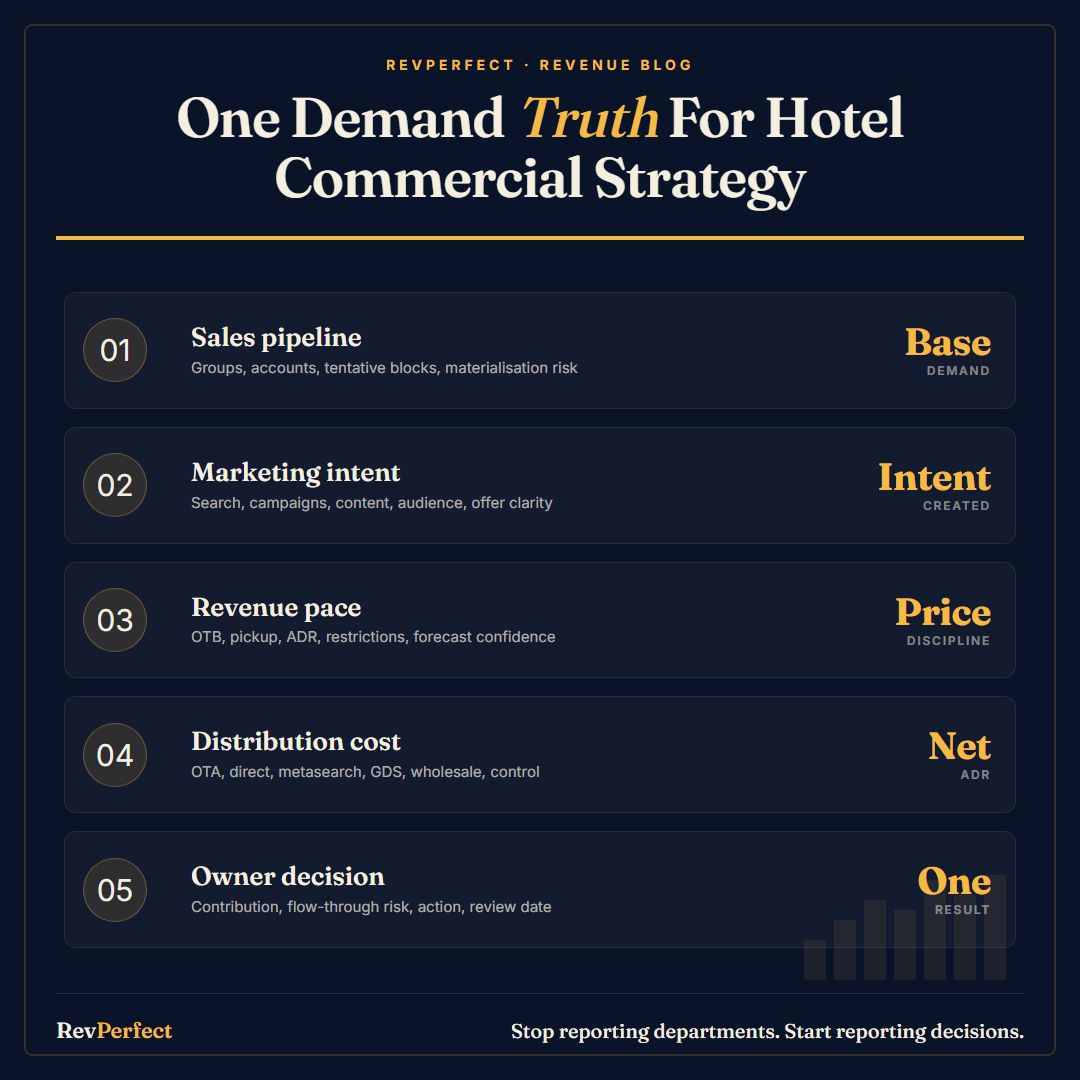
| Department story | Useful signal | The missing owner question |
|---|---|---|
| Sales has pipeline | Accounts, groups, tentative blocks | Which demand should the hotel actually keep? |
| Marketing has intent | Search, campaign, content, audience movement | Is it creating the right segment at the right cost? |
| Revenue has pace | OTB, pickup, ADR, restrictions, forecast | Does the rate plan match the demand source? |
| Distribution has volume | OTA, direct, metasearch, GDS, wholesale | What survives after channel cost and control? |
The trend is real, but the trap is old
The market language is moving toward commercial strategy. HSMAI describes its Commercial Strategy Conference as the convergence of marketing, revenue optimisation, sales, and distribution into newer commercial organisations inside hotel companies. Cloudbeds frames commercial strategy as sales, marketing, and revenue management under one coordinated model with shared data, KPIs, and accountability. Lighthouse has written for years about the difficulty and upside of aligning hotel marketing with revenue management.
That is why this topic keeps showing up on LinkedIn. Operators can feel the pain. The guest journey no longer respects the hotel org chart. Demand can start inside AI search, move through paid media, validate on an OTA, compare on metasearch, call sales for a group rate, then land in the PMS as a booking that the revenue manager has to explain.
The trap is that hotels hear "commercial strategy" and create another meeting. Then the meeting inherits the same old problem: separate reports, separate incentives, separate definitions of success, and one owner trying to work out why every department is proud while the month still feels soft.
One demand truth is the operating layer
One demand truth means every meaningful commercial decision carries the same minimum context: source of demand, segment, rate or offer, booking window, channel cost, operational constraint, and owner result. If those fields are missing, the team is not making a commercial decision. It is making a department decision and hoping the other departments adapt.
Revenue management should not be reduced to rate control. Sales should not be reduced to room-night volume. Marketing should not be reduced to campaign efficiency. Distribution should not be reduced to visibility. Each team sees part of the demand picture. Commercial strategy is the habit of stitching those parts together before the hotel spends money, opens inventory, accepts a group, cuts a package, holds rate, or changes channel exposure.
A 120-room example
Take a 120-room hotel with a soft August midweek pattern. Sales has a corporate group asking for 38 rooms on a Tuesday and Wednesday at A$176. Marketing wants to run a local events campaign with a A$1,800 spend. Revenue sees the same dates pacing 14 rooms behind last year but knows the following weekend is strong. Distribution sees OTA share rising on the need dates because a preferred visibility lever has started to pull demand at a higher effective cost.
If those reads stay separate, the hotel gets four arguments. Sales says take the base. Marketing says create demand. Revenue says protect rate. Distribution says the OTA is filling the gap. Each argument is reasonable. None is enough.
| Option | Room nights | Gross room revenue | Cost or constraint | Commercial read |
|---|---|---|---|---|
| Accept group at A$176 | 76 | A$13,376 | Displaces some late transient, holds meeting space | Useful base if catering and account value are real |
| Run event campaign | Estimated 28 | A$6,720 at A$240 ADR | A$1,800 media spend plus offer dilution risk | Good only if the audience converts direct and early |
| Let OTA fill the gap | Estimated 34 | A$7,990 at A$235 ADR | 18 percent channel cost and weak guest ownership | Volume helps occupancy but may hide margin leakage |
| Hold rate and wait | Unknown | Unknown | Forecast risk and owner anxiety | Only sensible if compression evidence is strong |
The commercial answer is not automatically one option. It might be a tighter group offer with catering minimums, a smaller direct campaign aimed at the same segment, reduced OTA exposure once base is protected, and a rate rule that opens only where pickup stays behind. The point is that the decision is built from one shared demand read. The owner can see what demand was accepted, what demand was stimulated, what channel cost was avoided, and what result will be reviewed after the dates close.
The six fields every commercial decision needs
I would not let a commercial meeting move to action until six fields are named. They are plain because they have to survive real hotel work.
- Demand source: account, campaign, OTA, direct, metasearch, event, AI-visible content, consortia, GDS, wholesale, or repeat guest.
- Segment and stay shape: transient, corporate, group, leisure, package, length of stay, day of week, lead time, cancellation risk.
- Price and offer: BAR, fenced rate, package value, inclusion, discount, room type, and the reason the guest should choose this path.
- Channel economics: commission, media cost, payment cost, sales cost, loyalty cost, and whether the hotel owns the guest relationship.
- Operational pressure: labour, breakfast, housekeeping, meeting space, parking, service recovery, and any cost that turns revenue into weaker contribution.
- Owner result: expected room revenue, total revenue, contribution, flow-through risk, and the line that will be reported after close.
Those fields stop the meeting from treating pipeline, campaign traffic, ADR, and OTA production as separate wins. They force the team to answer the only useful question: which demand should this hotel keep, stimulate, price higher, fence tighter, or let go?
When the stories disagree
| Conflict | What it usually means | Commercial response |
|---|---|---|
| Sales pipeline up, pace still soft | The business is tentative, low-rated, or poorly timed | Qualify materialisation, displacement, and account value before counting it as base |
| Marketing traffic up, direct bookings flat | Intent is not reaching the booking path | Check offer clarity, landing page, booking engine, and device conversion |
| ADR strong, OTA share rising | Rate discipline may be hiding channel-cost drift | Read net ADR and contribution by source, not just headline ADR |
| Occupancy up, owner pressure up | Demand is adding operational cost or weak mix | Rebuild the view around contribution and flow-through |
The weekly operating model
Keep the meeting short enough that it actually happens. Start with a single shared demand read: next 30 days by day type, segment, channel, and owner risk. Then let each function add only the evidence that changes a decision.
Sales brings the pipeline that can change the base. Marketing brings the demand signals that can change the audience or offer. Revenue brings the pace and price rules that can change inventory and rate. Distribution brings the channel economics that can change where the hotel accepts volume. Operations brings the cost and service constraints that can change whether the demand is worth keeping.
The output should be one page. Not a transcript. One page with five lines: decision, owner reason, expected impact, accountable owner, and review date. If the decision cannot be written that way, the meeting probably produced alignment theatre instead of commercial strategy.
What to avoid
Avoid renaming the revenue meeting and calling it commercial strategy. Avoid making the revenue manager referee every department without giving them access to source data. Avoid marketing campaigns that do not carry rate and segment context. Avoid sales targets that reward room nights without contribution. Avoid distribution dashboards that celebrate volume without net ADR. Avoid owner reports that show everyone worked hard but not which commercial call changed the month.
Most of all, avoid the phrase "we need better collaboration" when the real issue is that the hotel has no shared commercial object. Collaboration is a behaviour. One demand truth is the object the behaviour needs to gather around.
Sources and further reading
For the industry shift behind this article, see HSMAI's Commercial Strategy Conference, which describes the convergence of marketing, revenue optimisation, sales, and distribution; Cloudbeds' guide to building a hotel commercial strategy; Lighthouse on aligning marketing with revenue management; and CoStar's coverage of team alignment as a hotel commercial strategy priority. For adjacent RevPerfect reads, start with hotel channel mix strategy, channel and segment mix shift, hotel revenue meeting agenda, owner-ready revenue reports, and hotel flow-through.
FAQ
What is hotel commercial strategy?
Hotel commercial strategy is the operating model that connects revenue management, sales, marketing, and distribution around one demand plan, one scorecard, and one owner-ready view of total commercial performance.
Why do hotel commercial teams need one demand truth?
One demand truth prevents each department from optimising a local metric while the hotel misses the better owner result. It puts pace, segment mix, channel cost, offer quality, and profit impact into the same decision context.
Which teams belong in hotel commercial strategy?
Revenue management, sales, marketing, distribution, and operations all belong when their decisions affect demand, price, channel cost, service pressure, guest ownership, or owner reporting.
What should owners see in a commercial strategy report?
Owners should see the shared demand read, the segment and channel mix behind it, the commercial decision taken, the expected revenue and contribution impact, and the owner result after the period closes.
The closer
One hotel. One month. One owner result.
The commercial team can still have different skills. It should not have different truths. If sales, marketing, revenue, and distribution cannot explain the same demand picture, the owner is not looking at a strategy. The owner is looking at departments.
That is the shift. Stop asking whether every team has a good story. Ask whether the hotel has one demand truth, one decision, and one result it can defend after the date closes. At RevPerfect, this is the kind of source-to-owner bridge we care about: pace, segment, channel, contribution, and decision all on the same page. Book a 30-minute walkthrough.