
Revenue blog - AI search - 2 July 2026
Hotel AI referral capture: stop losing the booking after the shortlist
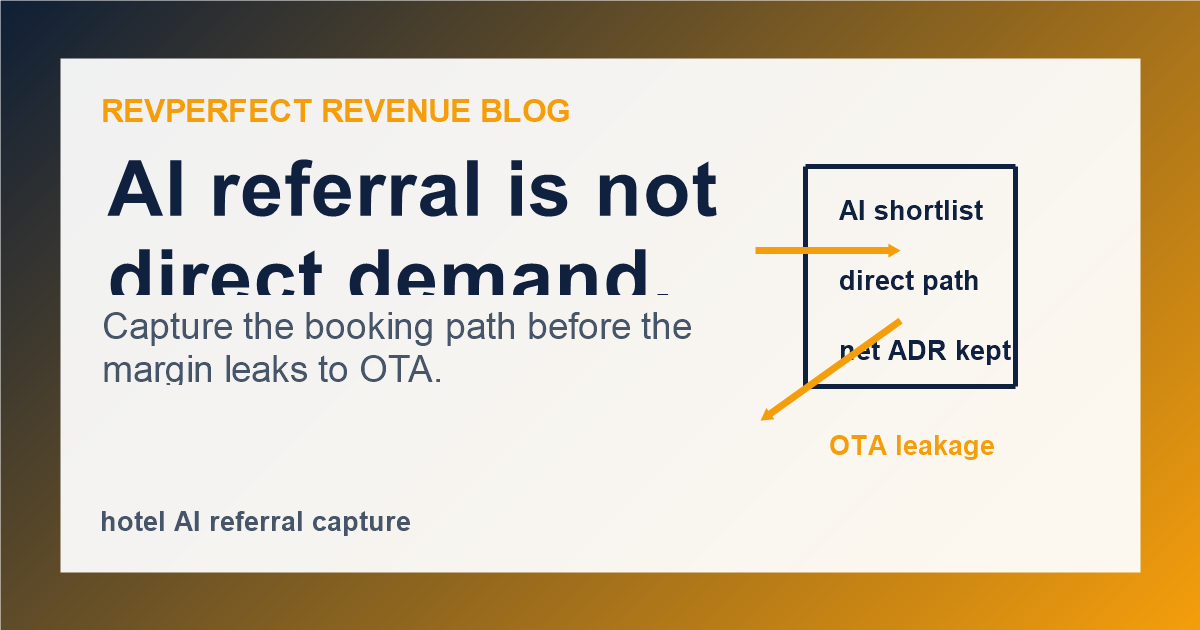
The AI answer is not the booking.
That is the mistake I see coming. A hotel appears in an AI travel answer and the team celebrates visibility. The property made the shortlist. The model understood the hotel. The brand finally showed up before the OTA. Good. But the guest still has to do the next thing. If the next thing is a generic search, a familiar OTA link, a slow mobile page, or a booking engine that makes the direct path feel harder, the hotel created demand and let someone else collect the margin.
Hotel AI referral capture is the operating layer after AI visibility. It asks whether the hotel can turn an answer-engine recommendation into a direct, measurable, margin-protected booking path.
AI discovery creates the shortlist. Revenue management has to protect what happens after the shortlist.
The answer-to-booking bridge
| Step | What can leak | What to own |
|---|---|---|
| AI mention | The hotel is named with no direct path | Answer-ready pages and entity clarity |
| Guest validation | The guest searches the hotel and sees OTA pages first | Fast direct page, clean snippets, strong value proof |
| Rate comparison | OTA convenience beats direct confidence | Parity-safe perks, package clarity, mobile booking speed |
| Booking attribution | The hotel cannot prove where demand came from | Tagged landing paths and source-aware reporting |
Visibility is not the commercial result
AI travel discovery is changing the first step of demand formation. Google has rolled AI Mode into search as a conversational way to plan trips. Expedia Group has built AI trip-planning and booking assistance into its consumer flow. OpenAI has made travel queries feel more conversational and source-led. Guests are learning to ask for "a quiet hotel near the CBD with parking, late checkout and a proper breakfast" instead of typing a brand or a destination page.
For hotels, that changes the revenue meeting. The question is no longer only, "do we rank?" It is, "if an AI assistant names us, can the guest book us directly without friction?"
This is why I would not let AI visibility sit with marketing alone. The revenue team owns the margin consequence. If the hotel wins the recommendation but loses the booking path to an OTA, the P&L reads that as distribution cost, not as brand progress.
The four leaks after an AI recommendation
The first leak is validation leakage. The guest sees the hotel in an answer, then searches the name. If the direct site is thin, slow, unclear, or buried beneath OTA pages, the guest chooses the path that feels safer. The hotel was visible but not trusted enough.
The second leak is rate leakage. The guest reaches the direct path but does not understand why booking direct is at least as safe as the OTA path. The hotel may have parity, but parity is not persuasion. Direct needs clarity: cancellation terms, inclusions, loyalty value, parking, breakfast, late checkout, room differences, and what the guest will actually get.
The third leak is device leakage. AI travel search often starts on mobile. A mobile page that loads slowly, hides room detail, or pushes the booking button below clutter will send the guest back to the familiar marketplace. The OTA did not steal the booking at the rate line. It won at the interface line.
The fourth leak is attribution leakage. The hotel sees a direct booking but cannot connect it to an AI-visible query, article, destination page, brand search, or owner-report campaign. When the source is invisible, the team cannot decide which content, package, or rate path deserves more investment.
AI referral capture rate
AI referral capture rate = direct booking starts from AI-visible paths / qualified AI-referred visits
| Qualified visit | A session landing on an AI-citable hotel page, offer page, or tracked brand-search path. |
| Direct start | A booking-engine search, room selection, or package click the hotel controls. |
| Owner adjustment | Read alongside net ADR, channel cost avoided, and conversion by device. |
A 120-room example
Take a 120-room independent hotel. The property publishes a strong local guide about family stays near the stadium, parking, breakfast, and late checkout. Over a month, the page starts appearing in AI answers and referral-like sessions rise. The marketing report says visibility improved. The owner wants to know whether that changed cash.
Here is the revenue read. The page sends 1,200 qualified visits. Of those, 180 start the booking engine. Fifty-four complete direct bookings at A$235 ADR and 1.8 nights average length of stay. Another 96 visits search the hotel name and later appear to book through OTA demand at an estimated A$235 gross ADR with an 18 percent channel cost. The rest do not convert inside the observation window.
| Path | Room nights | Gross revenue | Distribution cost | Owner read |
|---|---|---|---|---|
| Captured direct | 97 | A$22,795 | A$684 payment/servicing estimate | Demand kept |
| Likely OTA leakage | 173 | A$40,655 | A$7,318 commission estimate | Demand created, margin leaked |
| Unconverted | - | - | - | Friction or weak intent |
The article worked. The hotel was visible. But the operating opportunity is not "write more AI content" by itself. The opportunity is to improve the bridge: clearer room proof, faster mobile booking, better direct-value language, tagged landing paths, and a rate path that does not ask the guest to compare uncertainty.
What the revenue manager should ask
Start with five questions. They are deliberately plain.
- Which AI-visible pages are creating qualified hotel intent? Destination pages, package pages, venue guides, parking pages, family pages, and owner-ready explainers all behave differently.
- Where does the guest go next? Direct booking engine, brand search, OTA result, maps, metasearch, phone call, or nothing.
- What is the direct-path conversion by device? Mobile matters because AI discovery is often mobile-first and high-friction booking engines punish that path.
- What is the net ADR difference between captured direct demand and leaked OTA demand? The owner needs the margin bridge, not the visibility story.
- Which promise made the hotel citeable? Parking, breakfast, location, quiet rooms, family facilities, flexible cancellation, meeting space, or rate value. The promise should appear again on the booking path.
If AI visibility rises, what moves?
| Signal | Diagnosis | Revenue action |
|---|---|---|
| Mentions up, direct starts flat | The answer is not handing off cleanly | Improve direct page, snippets, internal links, and booking CTA |
| Direct starts up, completion flat | Booking engine friction or rate doubt | Fix mobile path, room proof, terms, and parity-safe value |
| Brand searches up, OTA share up | Guest validates through marketplaces | Strengthen brand SERP, maps, direct value, and metasearch hygiene |
| Direct bookings up, net ADR down | Demand was captured but discounted too hard | Review package fences and contribution by source |
The owner-ready version
Do not report AI visibility as a vanity line. Report it as a demand handoff.
A weak owner note says: "AI visibility improved and direct traffic rose." That leaves the owner to guess whether the hotel made money.
A stronger owner note says:
AI-visible pages generated 1,200 qualified visits. Direct booking starts converted at 15 percent, but brand-search leakage to OTA paths appears high on mobile. We moved the stadium page to a faster direct offer path, added cancellation and parking proof above the fold, and will report captured direct contribution beside OTA leakage next month.
That is the standard. It names the demand, the leak, the action, and the next reporting line. The owner does not need a lecture about answer engines. The owner needs to know whether the hotel kept the demand it helped create.
The weekly capture checklist
Keep the checklist short enough to survive a real revenue meeting. Review the AI-visible pages that produced demand, the landing path those pages used, the booking-engine start rate, the mobile completion rate, the visible OTA comparison, and the net ADR of the bookings that landed. If one of those lines is missing, the team is not yet measuring capture. It is only measuring attention.
The best version is boring and repeatable. Every week, pick the two pages or prompts that created the strongest intent. Check whether the direct path still matches the promise that made the hotel citeable. If the AI answer praised parking, the direct page should not bury parking. If the answer praised breakfast, the package and room page should make breakfast clear. If the answer praised location, the mobile page should make the location advantage visible before the guest starts comparing maps and OTA filters.
This is not about chasing every AI mention. It is about protecting the few moments where the guest has already shown useful intent. Those moments deserve the same discipline as a high-demand date: define the path, remove the friction, protect the margin, and report the result.
Sources and further reading
For the platform shift behind this topic, see Google's AI Mode travel planning update, Expedia Group's AI Trust Gap research, and OpenAI's ChatGPT search overview. For adjacent RevPerfect reads, start with AI search for hotels, how to grow direct bookings, OTA revenue vs direct revenue, hotel booking conversion rate, and Net ADR.
FAQ
What is hotel AI referral capture?
Hotel AI referral capture is the ability to turn a recommendation from an AI assistant or answer engine into a direct, measurable booking path instead of letting the demand leak to an OTA or generic search result.
Why does AI travel discovery create OTA leakage risk?
AI travel discovery can name a hotel before the guest visits a website, but the guest may still click the easiest booking path. If OTA pages, metasearch links, or weak direct pages dominate the next step, the hotel created demand but did not keep the margin.
What should hotels measure after AI visibility improves?
Hotels should measure AI-mentioned queries, direct landing-page sessions, booking-engine starts, OTA price exposure, net ADR by source, conversion by device, and whether the guest reaches a rate or package the hotel controls.
How can a hotel protect direct bookings from AI referrals?
Protect direct bookings by making the direct path answer-ready, fast, mobile-clean, rate-clear, parity-safe, and attributable. The hotel should link the AI-visible content to a booking path that explains value before the guest compares OTA convenience.
The closer
AI can introduce the hotel. It cannot protect the margin.
The commercial work starts after the answer: prove the hotel, clarify the direct value, remove mobile friction, tag the path, and show the owner what demand was kept versus what leaked.
That is why hotel AI referral capture belongs in the revenue meeting. The answer engine may create the shortlist, but the hotel still has to win the handoff. At RevPerfect, this is the kind of source-to-owner bridge we care about: visibility, booking path, net contribution, and decision all on the same page. Book a 30-minute walkthrough.